Your deal model counts revenue, headcount, EBITDA and the synergies you expect to realize.
It does not count the estate.
An acquisition buys you a second set of everything: another website on another platform, another content system, another commerce stack, another set of customer records, another set of reporting definitions. None of it appears in the LOI. All of it arrives on day one.
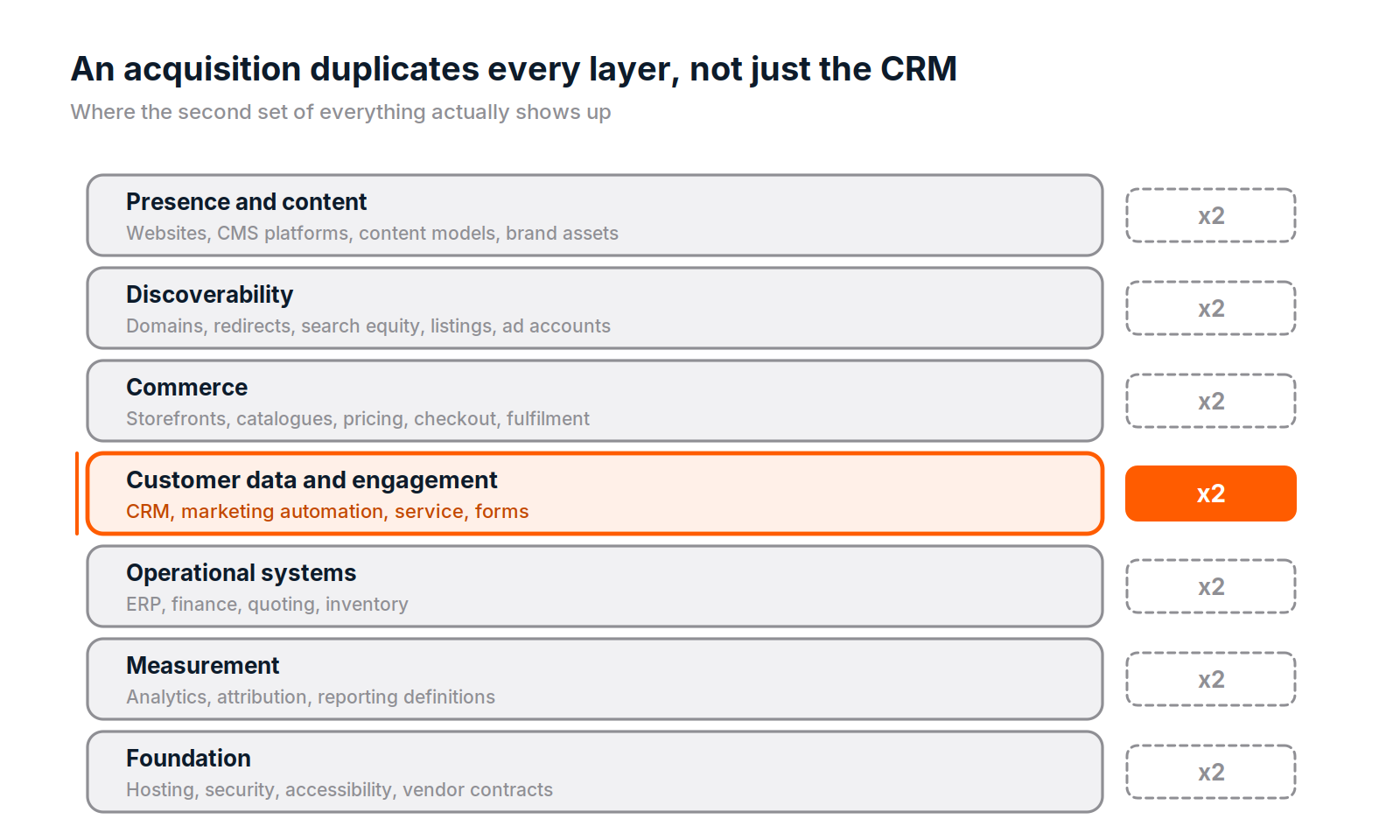
This is usually treated as an IT matter, handled after close, by people who were not in the deal. That framing is the expensive part, because it moves a priceable cost into the one period where nobody is looking for it.
What it actually does to the model
Three effects, and the first one is the one that should worry a deal team most.
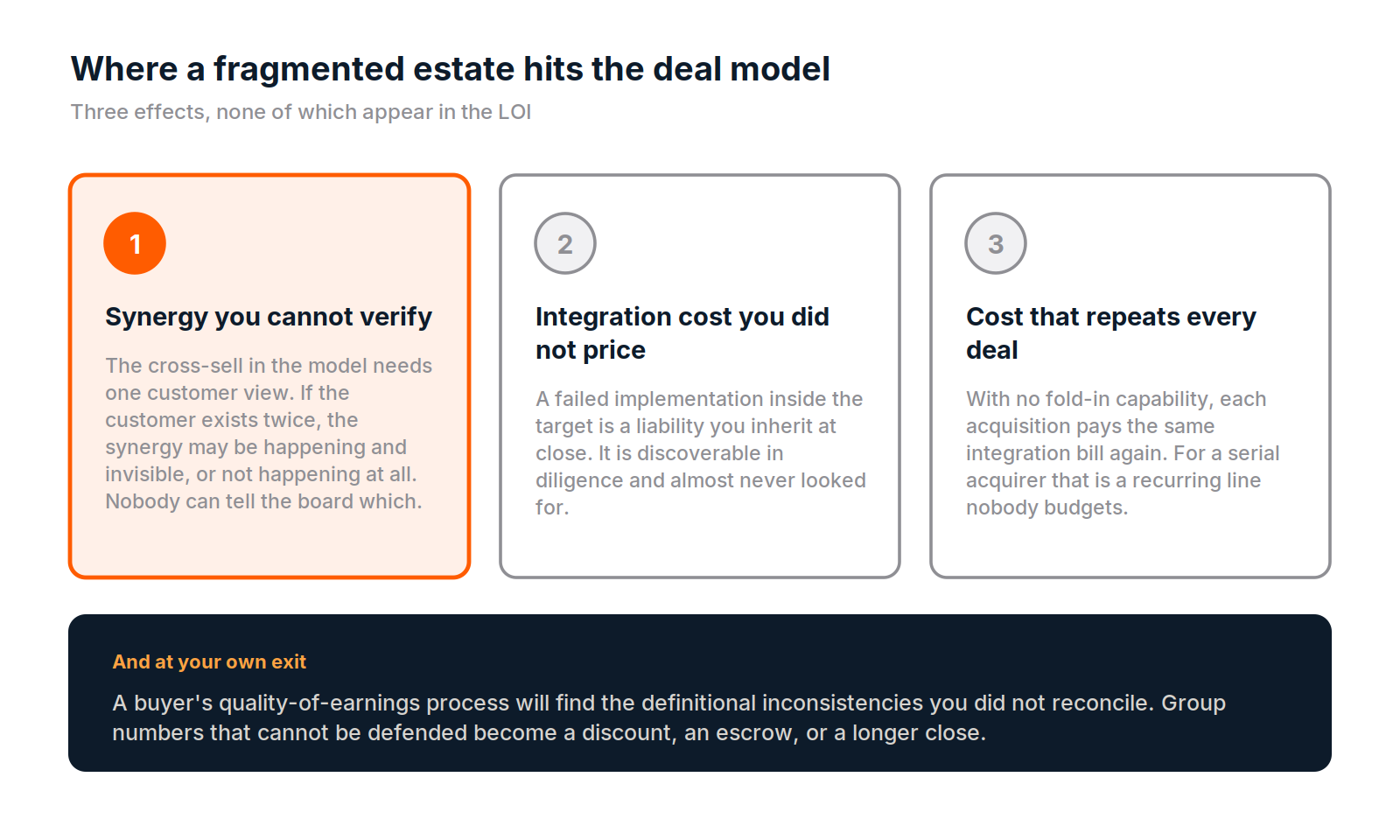
The synergy becomes unverifiable. Most acquisitions in adjacent categories are underwritten partly on cross-sell. That synergy requires a single view of the customer. If the same customer exists twice, in two systems, with two identifiers and two spellings, then the cross-sell may be happening and invisible, or not happening at all.
Nobody can tell the board which. The number you underwrote becomes a number you cannot defend.
We worked with a group whose four brands sat in a genuine sequence: a risk assessment, then equipment safeguards, then the labels that went on the equipment. A customer buying all three was the entire thesis. Cross-sell was tracked by hand, in a spreadsheet, because nothing in the business could see it.
The integration cost was already there when you signed. A failed implementation inside the target is a liability you inherit. That group had attempted a CRM programme before and it had not stuck: failed data sync, duplicate records, unclear ownership, and finally a sales team that stopped trusting the system and went back to spreadsheets.
Three of those are engineering problems. The fourth is not. Once trust is gone, the next programme costs more and takes longer, and no amount of new software shortens that.
All of it was discoverable before close. Nobody asked.
And the cost repeats. If no capability exists for absorbing a company, the next deal pays the same integration bill again, improvised by the same people, who are now also maintaining the last one. For a serial acquirer that is a recurring line that never reaches the plan.
At your own exit
This cuts both ways, and it is the argument that tends to land with a CFO.
A buyer's quality-of-earnings process will find the definitional inconsistencies you never reconciled. One business counting a deal at proposal and another at signature is not a reporting quirk at that point. It is a question you cannot answer in a room where answers are priced.
Group numbers that cannot be defended become a discount, an escrow, or a longer close.
What to ask before you sign
None of this requires a technologist in the diligence room.
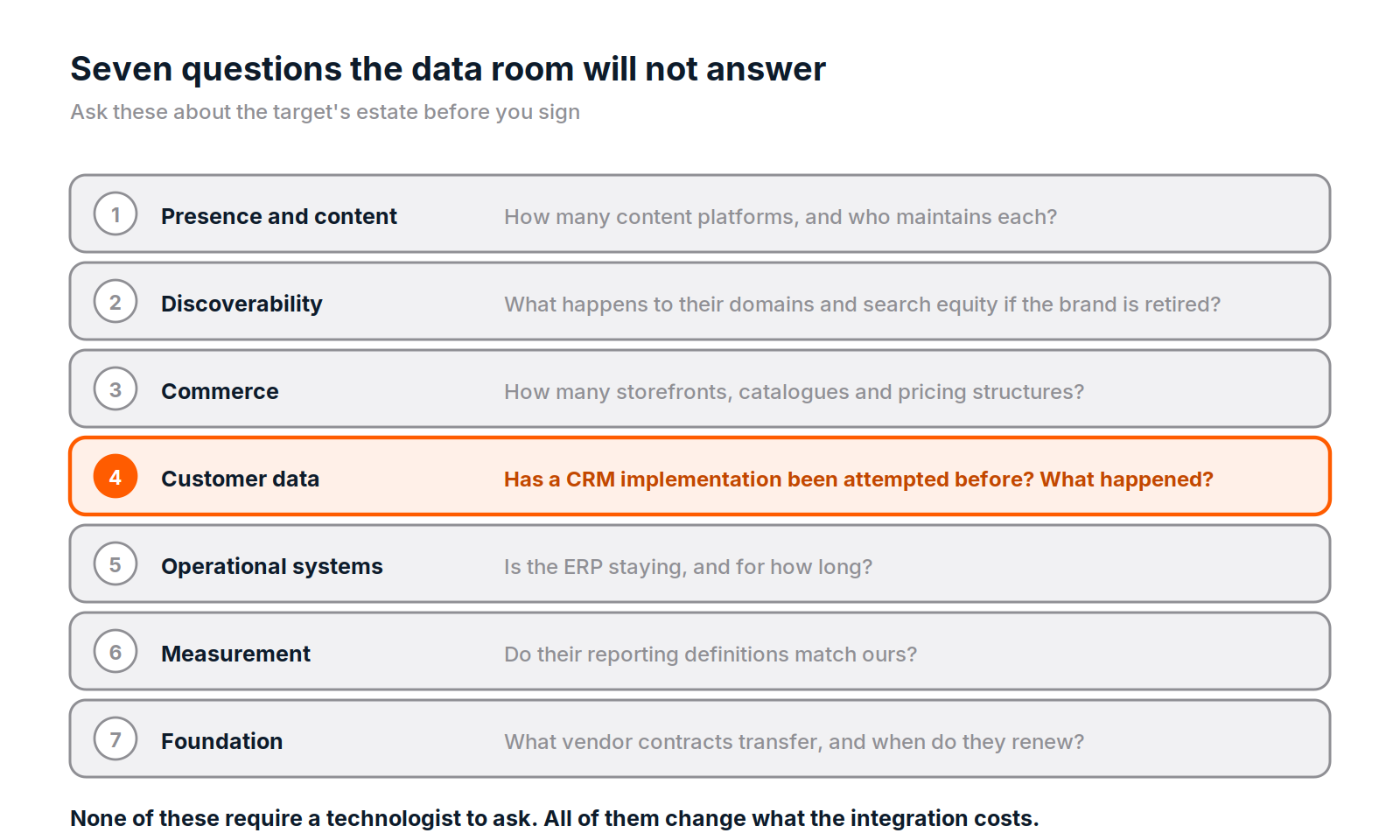
The fourth question is the one we would put first.
Has a CRM or platform implementation been attempted here before, and what happened to it? A clean answer means the integration is an engineering exercise. A messy one means you are buying a trust problem as well as a technical one, and the cost of that belongs in your model, not in next year's surprise.
The second question is the one most often skipped and the fastest to cost real money. Retire an acquired brand with the redirects wrong and the search equity built over fifteen years goes with it. That is demand the target already paid for, written off in a quarter.
The point
Digital fragmentation is not a post-close IT project. It is a liability sitting inside the target at signing, visible from outside, answerable in diligence, and almost never priced.
Groups that handle it well are not the ones with the largest technology budgets. They are the ones that decided early, and explicitly, what happens to a company's systems when it joins. That decision turns an eighteen-month surprise into a line item at the term sheet.
If you are acquiring every few months and that decision has not been made, it is being made anyway. Slowly, by default, and at a price you will find out later.